
Relationships and Sex Education and Health Education (RSHE) Information
From September 2020, Relationships and Sex Education (RSE) became statutory in all secondary schools in England. As part of our work to ensure that we are meeting this requirement, we would like to give you some information about what exactly we are expected to deliver to our pupils.
In response to the statutory changes to the curriculum of Relationships, Sex and Health Education (RSHE) in September 2025, we have updated our policy.
The legislation makes it clear that all schools should approach RSE in a faith sensitive and inclusive way, seeking to explain fairly the tenets and varying interpretations of religious communities on matters of sex and relationships and teach these viewpoints with respect. We understand our very diverse community here at NGA and want our RSHE to represent a range of faith perspectives. We are using the document ‘Faith and Relationships’ produced by Nottingham City Council and the Nottingham Standing Advisory Council on Religious Education (SACRE) to support teachers to share a range of faith views on different topics in addition to the law. ‘Faith and Relationships’ was created by representatives from local faith groups, including from the Karimia Institute, Hinduism Education Services and Nottingham Sevadaar (click here).
Statutory education
In 2020, the following subjects became compulsory in applicable schools in England:
-
Relationship and Sex Education in secondary schools
-
Health Education in state funded secondary schools
These subjects support all young people to be happy, healthy and safe, equipping them for life as an adult in British society.
Some parts of the new curriculum, as with the current curriculum, are compulsory. These are part of the national curriculum for science.
This is set out in the Department for Education's (DfE) guidance.
Why it changed
The DfE included in their Impact Assessment report on RSE (2019) that incorporating RSE as part of the compulsory curriculum has a great number of benefits for the students.
On the one hand, young people will have more information available to them, which will enable them to make informed choices. The changes meant that young people will be able to access an RSE provision that is “planned, age-appropriate and developmental” (DfE, 2019) regardless of the school they attend.
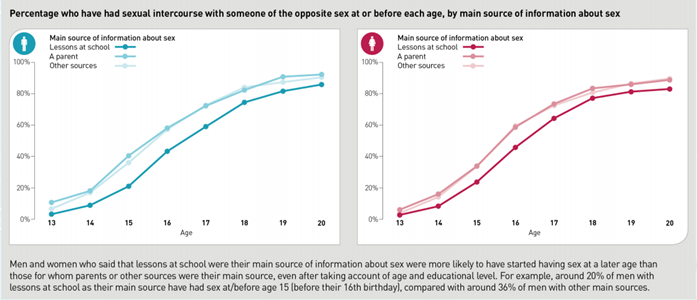
There is evidence in research that suggests that Relationships and Sex Education can help students make informed decisions to keep themselves safe when it comes to recognising sexual abuse or using contraception and it can potentially result in delaying the age of first intercourse (DfE, 2019).
You can see this evidence on the following graph created by the Sex Education Forum which analyses the results of the latest Natsal survey:
For more information on this, you can visit:
https://www.sexeducationforum.org.uk/sites/default/files/field/attachment/SRE%20-%20the%20evidence%20-%20March%202015.pdf
Right to withdraw:
Parents/carers have the right to withdraw their child from part or all of the sex education delivered as part of RSE. What is considered to be ‘sex education’ is set out by the school in our policy. Parents/carers can do this until 3 terms before their child turns 16. After that, it will be the young person’s decision.
Parents cannot withdraw their child from the Relationships or Health education part of RSHE nor from the sex education elements of the Science curriculum.
If a pupil is withdrawn, a meeting between the parent, the Principal and the PSHE coordinator must take place as it will be the Academy’s responsibility to ensure the student is going to receive appropriate, purposeful education during the withdrawal period.
Below there is an opportunity to read our PSHE Policy (with the changes to RSHE in) and a link to the Withdrawal Form.
PSHE Revised Policy
PSHE POLICY - FOCI ON RELATIONSHIPS AND SEX EDUCATION AND HEALTH EDUCATION (RSHE)
Withdrawal Form
PARENT AND CARER FORM - WITHDRAWAL FROM SEX EDUCATION WITHIN THE RSE CURRICULUM
To know more:
To read more about the Government’s expectations on this matter, please click the following link: https://assets.publishing.service.gov.uk/government/uploads/system/uploads/attachment_data/file/812594/RSE_secondary_schools_guide_for_parents.pdf
Finally, if you want to have access to the Government’s guide on Relationships (and sex) education and health education (updated statutory guidance and consultation outcomes), DfE, February 2019 please click the following link: https://www.gov.uk/government/publications/relationships-education-relationships-and-sex-education-rse-and-health-education
Frequently asked questions:
Throughout the Government’s engagement and development process of this new RSE curriculum, a number of wide-ranging concerns have been heard. To support you with understanding this change in your child’s education, you can access some of the frequently asked questions that help address misconceptions on this matter on the webpages below:
https://www.sexeducationforum.org.uk/resources/frequently-asked-questions
We want to take this opportunity to thank you for your contribution. We are going to continue to reach out to parents. Therefore, if you would like to raise anything regarding our RSHE curriculum further please share your interest and email the PSHE Coordinator Ruth Gangneux on rgangneux@nottinghamgirlsacademy.org